Cyanuric Acid: How Much Stabilizer Is Too Much?
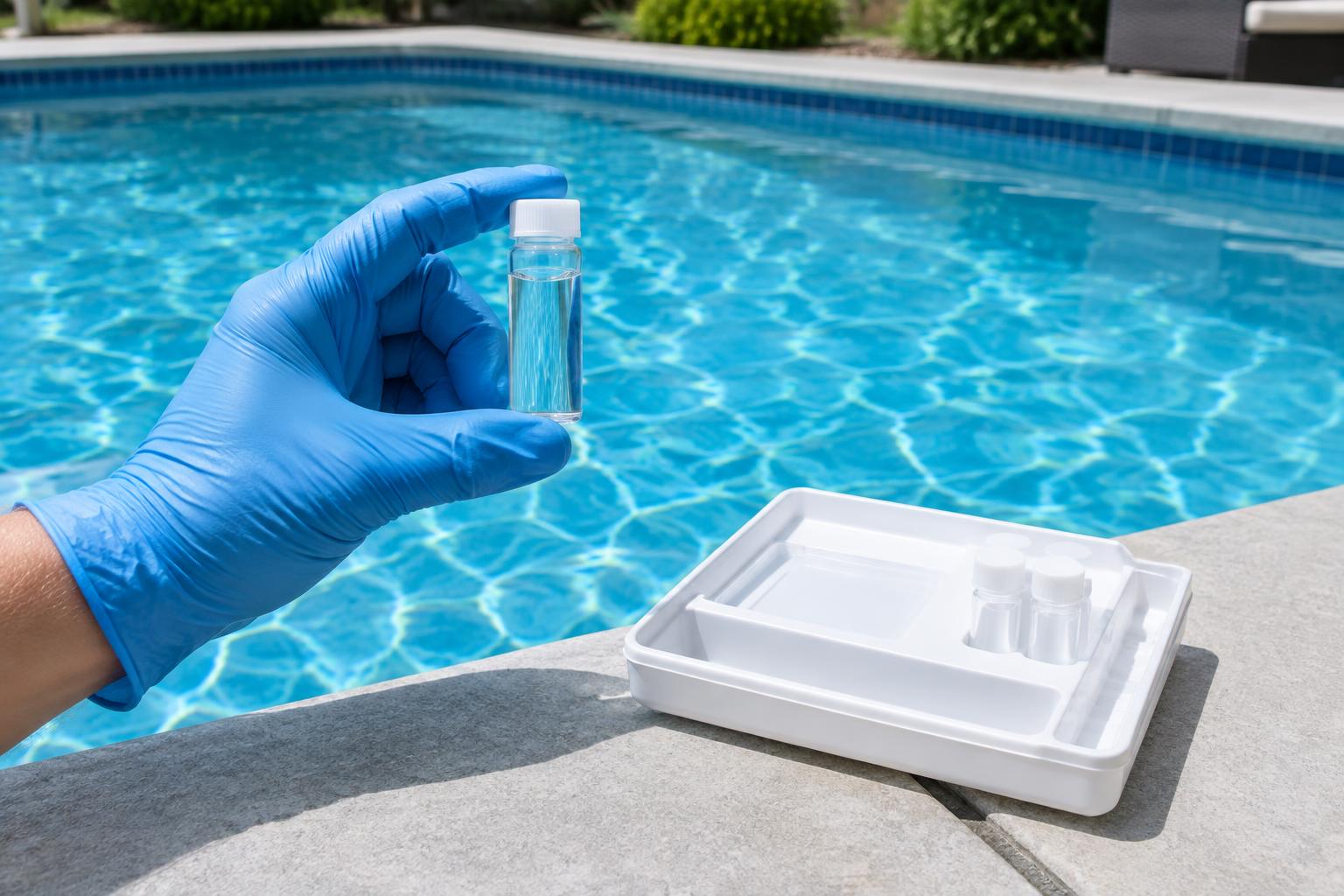
Cyanuric acid (CYA), also called pool stabilizer, may be too high when it exceeds your pool’s recommended range and makes effective chlorine management difficult. For many outdoor residential pools, 30–50 ppm is a common target; saltwater systems may specify 60–80 ppm. Above roughly 90–100 ppm, consider confirming the result and planning a reduction. Follow your equipment guidance and local requirements rather than treating one number as universal.
What cyanuric acid does in a pool
Cyanuric acid helps protect chlorine from sunlight. Without it, an outdoor pool may lose chlorine quickly during sunny weather, making it harder to maintain a consistent sanitizer residual.
The trade-off is that CYA binds reversibly with chlorine, reducing the immediately active portion. As stabilizer rises, the free chlorine level needed for effective algae control typically rises too. A chlorine reading that worked at low CYA may not be sufficient at a much higher level.
CYA can enter your pool through:
- Stabilizer or conditioner added separately.
- Trichlor tablets, sticks, or granules.
- Dichlor granular chlorine, including some products sold as shock.
Liquid chlorine and chlorine generated by a saltwater cell do not add CYA. Check the active ingredient rather than relying on terms such as “shock” or “weekly treatment.”
What is a good cyanuric acid level?
The right target depends on sunlight, pool type, equipment instructions, and applicable health requirements. These are practical starting points for outdoor residential pools, not universal operating limits.
| CYA reading | Typical interpretation | Practical next step |
|---|---|---|
| Below 20 ppm | Limited sunlight protection | Confirm the reading; consider stabilizer if your pool requires it |
| 20–30 ppm | May suit some outdoor setups | Monitor chlorine loss and check your recommended target |
| 30–50 ppm | Common target for manually chlorinated outdoor pools | Maintain chlorine according to CYA and applicable guidance |
| 60–80 ppm | Specified by some saltwater-system manufacturers | Verify your model’s instructions and chlorine requirements |
| Above 80 ppm | Higher than many residential targets | Stop unnecessary CYA additions and review management options |
| Around 100 ppm or higher | Often a reason to reduce CYA | Confirm the result and assess safe water replacement |
Indoor pools typically do not need sunlight protection. Public pools, spas, and specialty systems may have different restrictions; do not apply this table to them automatically.
A high reading is not usually an emergency by itself. However, inadequate sanitization, visible algae, or water too cloudy to see the bottom requires prompt attention. Keep swimmers out when water quality or visibility is unsafe.
Why high stabilizer can be a problem
Chlorine readings need context
A free chlorine test measures chlorine available in the water, including chlorine temporarily associated with CYA. It does not directly show how quickly that water can disinfect.
That means “my chlorine is in range” is incomplete without knowing the stabilizer level. Use a recognized chlorine/CYA operating guide appropriate for your residential pool, alongside product instructions and local requirements. Where those conflict or seem unclear, consult a qualified pool professional.
Routine tablet use can create gradual buildup
Stabilized chlorine can be convenient, but each dose also adds CYA. Unlike chlorine, stabilizer is not rapidly consumed while sanitizing the pool.
Evaporation does not meaningfully remove CYA: the water leaves, while dissolved stabilizer remains. Refilling after evaporation therefore does not provide the same reduction as removing pool water and replacing it.
Splash-out, backwashing, and overflow may remove some CYA, but not necessarily enough to balance regular additions from stabilized products.
How to confirm that your CYA is too high
Before replacing water, verify the result. Test strips can provide a useful screening estimate, but distinguishing nearby CYA levels by color may be difficult.
Consider a dedicated CYA turbidity test or a reputable pool-service test. Follow the test’s directions for lighting, water temperature, mixing, and viewing position. Many turbidity tests involve judging when a black dot disappears, so technique matters.
If your result reaches the top of the test’s scale, it may mean “at least this high,” not an exact value. Use only a dilution procedure approved for that test, or ask a professional to confirm it.
If you recently added stabilizer, allow the label-specified time for dissolution and circulation before retesting. Adding more too soon may cause an overshoot.
How to lower high cyanuric acid: step by step
1. Stop adding more stabilizer
Pause separate CYA additions and review any trichlor or dichlor products you use. Consider an unstabilized chlorine source that suits your pool and equipment.
Never substitute a different chemical into a tablet feeder. Residues from incompatible products can cause a dangerous reaction. Follow all product and feeder instructions when changing treatment methods.
2. Choose a realistic target
Use your pool type and equipment manual to select a target. For example, reducing CYA from 100 ppm to 50 ppm may make sense for a manually chlorinated outdoor pool. A saltwater pool may have a different recommended endpoint.
Test replacement water too if it could contain CYA, such as reclaimed or previously treated pool water.
3. Estimate the replacement needed
If replacement water contains no CYA, a useful estimate is:
Replacement fraction = 1 − (target CYA ÷ current CYA)
For a pool at 100 ppm with a target of 50 ppm:
1 − (50 ÷ 100) = 0.50, or approximately 50% replacement.
This assumes a single removal followed by refilling and thorough mixing. Several smaller exchanges typically require more total water because each later exchange removes some previously added fresh water.
4. Check whether water replacement is safe
Do not drain a pool blindly. Groundwater pressure can damage or lift a shell, and vinyl liners may shift or shrink. Local discharge restrictions, drought rules, and disposal requirements also matter.
Consult a professional before substantial draining, especially with high groundwater, uncertain construction, or structural concerns. In some areas, specialist reverse-osmosis services may offer an alternative; confirm suitability, availability, and cost.
5. Replace water, circulate, and retest
Use the method and limits recommended for your pool. Once refilled and thoroughly circulated, retest CYA, free chlorine, pH, alkalinity, and calcium hardness. Saltwater pools also need their salt level checked.
Fresh water changes more than stabilizer. Avoid automatically repeating your previous chemical doses.
6. Set a prevention routine
Track CYA periodically, particularly during regular stabilized-chlorine use. Record product names and amounts so you can identify the source of a rising reading.
PoolPilot AI can help organize your readings into an assessment with practical next steps. Upload your test results and add a pool photo for visual context: Analyze my pool — free. A photo alone cannot measure CYA or confirm that water is safe to swim in.
What usually will not fix high CYA
Adding more shock does not remove stabilizer; dichlor-based shock adds more. Ordinary filtration also does not remove dissolved CYA, although backwashing removes some by discarding water.
Do not confuse dilution from water replacement with simply topping up evaporation losses. And do not assume a product marketed as a CYA reducer will reliably achieve your target: performance may depend on water conditions and specific instructions.
Follow product labels, never mix chemicals, and add products separately as directed. For persistent algae, suspected contamination, or serious equipment or structural issues, consult a qualified professional.
FAQ
Is 100 ppm cyanuric acid too high?
For many outdoor residential pools, 100 ppm exceeds the preferred operating range and warrants a reduction plan. Confirm the reading first, especially if it is your test’s maximum value. Higher CYA also makes chlorine management more demanding.
Can I swim with high cyanuric acid?
CYA alone is not enough to decide. Effective sanitization, pH, clarity, and other conditions matter. Do not assume clear water or a familiar chlorine reading proves safety. Keep swimmers out if water quality is uncertain and seek professional guidance.
Does cyanuric acid go down on its own?
It typically persists unless water containing it leaves the pool. Natural breakdown can occur under some conditions, but it is not a dependable correction strategy. Evaporation alone does not lower the concentration after normal topping up.
Can PoolPilot AI assess my stabilizer reading?
PoolPilot AI can use uploaded test readings to provide an AI-powered assessment and suggested next steps. Include CYA, free chlorine, pH, pool type, and recent chemical additions for better context. You get three free assessments per month, with no credit card required: Analyze my pool — free.