How to Lower Pool pH Safely: A Step-by-Step Guide
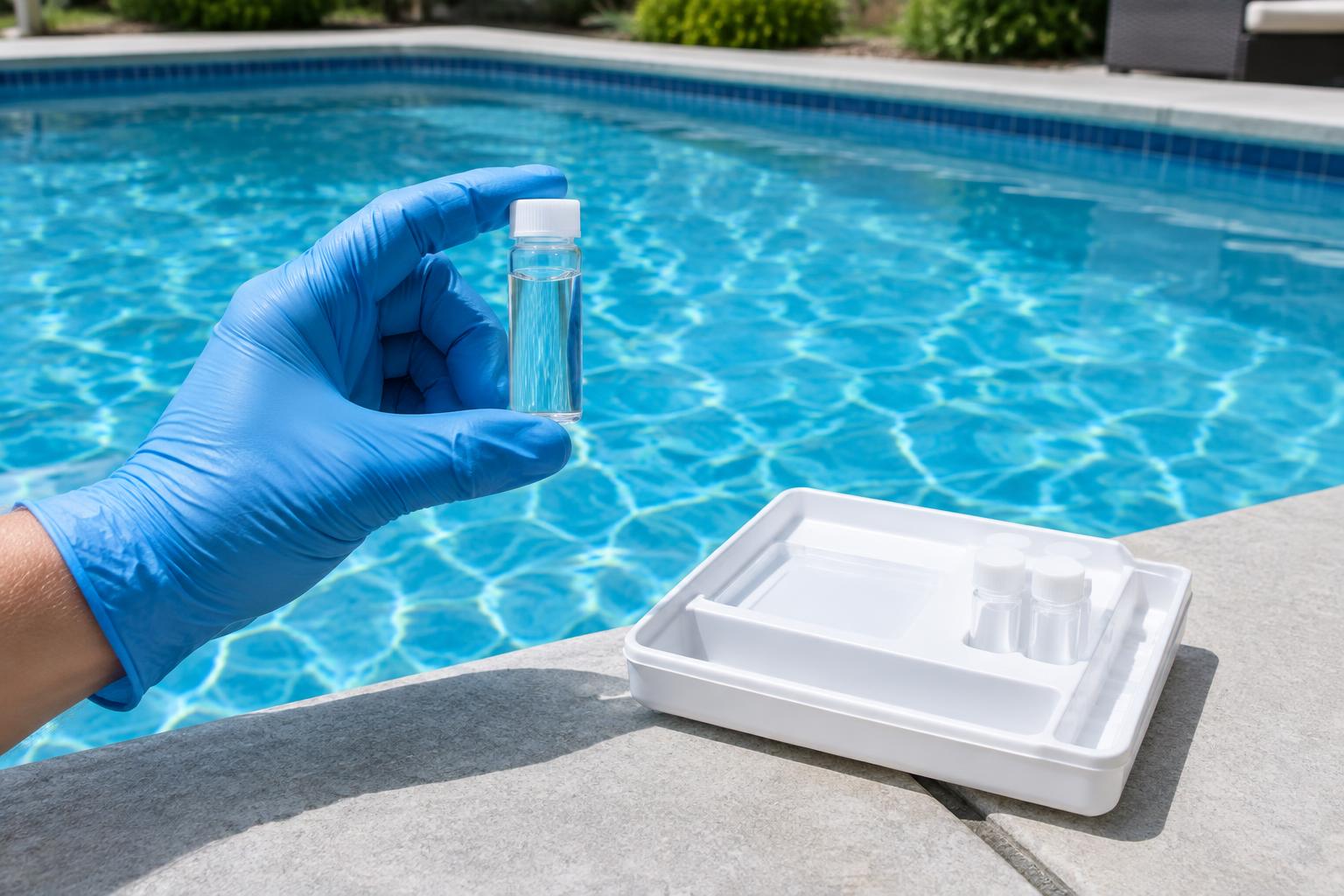
To lower pool pH safely, confirm the reading with a reliable test, check total alkalinity, and add a pool-approved pH reducer according to its label and your pool’s volume. Keep swimmers out, circulate as directed, and retest before adding more. Most residential pools typically aim for a pH of 7.2–7.8; lowering toward 7.4–7.6 may leave a useful buffer against overshooting.
Why high pool pH needs attention
High pH may encourage calcium scale, reduce water clarity, and contribute to swimmer discomfort. It also reduces the proportion of active chlorine at a given free-chlorine reading, although stabilizer levels complicate that relationship in outdoor pools.
Cloudiness or irritation alone does not prove that pH is high. Low sanitizer, combined chlorine, filtration problems, and other water-balance issues may cause similar symptoms. Test before treating rather than guessing from appearance.
Common reasons pH rises include aeration from waterfalls or spa jets, carbon dioxide escaping from the water, some chlorine products, and curing plaster in a new pool. High total alkalinity can make recurring pH rise harder to manage.
Check these things before adding a pH reducer
An accurate starting point matters more than a fast chemical adjustment.
| What to check | Why it matters | Practical next step |
|---|---|---|
| Current pH | Confirms whether adjustment is needed | Follow your test kit’s sampling and reading instructions |
| Pool volume | Acid doses depend on water volume | Verify gallons or liters rather than guessing |
| Total alkalinity | Buffers pH and affects acid demand | Measure it before choosing a dose |
| Product strength | Acid concentrations vary | Use the exact product’s label or dosing chart |
| Sanitizer level | Very high chlorine may interfere with some pH tests | Check your test kit’s interference limits |
| Recent chemical additions | Water may not yet be evenly mixed | Allow label-directed circulation before sampling |
Take your sample away from returns and chemical feed points. If a strip gives an unclear color, consider confirming it with a fresh liquid test kit or a qualified pool shop’s water test. A reading at the top of a test’s range may mean the actual pH is higher than the kit can show.
PoolPilot AI can help you interpret uploaded test readings and organize next steps. A pool photo may provide visual context, but it cannot reliably establish pH or replace a water test. Analyze my pool — free.
Choose the right pool pH reducer
Two common options are muriatic acid and sodium bisulfate, often called dry acid. Neither is automatically the best choice for every pool.
Muriatic acid
Muriatic acid is a hydrochloric acid solution commonly used to lower both pH and total alkalinity. Its strength varies between products, so instructions for one concentration should not be applied to another.
It can cause serious burns and release irritating fumes. Use only a product labeled for your pool application, with the protective equipment and handling precautions specified on the label. If you cannot handle it safely, consider professional service.
Sodium bisulfate, or dry acid
Dry acid is a granular pH reducer that also lowers alkalinity. It may be convenient to measure, but it is still corrosive and requires careful handling.
It adds sulfates to the water, which may matter for certain finishes, equipment, or repeated long-term use. Check pool and equipment manufacturer guidance, particularly for saltwater systems. Do not substitute household acids or improvised chemicals for a pool-approved product.
How to lower pool pH safely: step by step
-
Keep swimmers out and prepare the area. Read the entire product label before opening the container. Wear the specified eye protection, gloves, and other protective equipment. Keep children and pets away, and avoid breathing fumes or dust. Do not proceed if safe handling conditions are unavailable.
-
Confirm pH, alkalinity, and pool volume. Record your readings and choose a target within the recommended range. If pH is already acceptable, adding acid simply to hit an exact number may be unnecessary. If alkalinity is low or readings seem inconsistent, resolve that uncertainty first.
-
Determine a product-specific dose. Use the label’s dosing directions or an appropriate acid-demand test with its accompanying instructions. Dose requirements depend on volume, alkalinity, starting pH, target pH, and acid strength. There is no universal “one cup per pool” rule. If the instructions do not cover your situation, ask the manufacturer or a pool professional.
-
Add the product exactly as directed. Run circulation if the label requires it, and use the specified application location and method. Never mix chemicals, including different acids or acid and chlorine. Their contact can release dangerous gas. Do not pour acid into a skimmer or chemical feeder. Never improvise a dilution method: if the label specifically requires dilution, add acid to water, never water to acid.
-
Allow the specified mixing time. Keep the circulation system operating as directed. Do not immediately sample beside the addition point, where a concentrated pocket may distort the reading. Avoid adding another chemical while the acid is dispersing; follow all product-specific separation and waiting instructions.
-
Retest before deciding on another dose. Check pH and total alkalinity again after the required circulation period. If pH remains high, make another label-directed adjustment rather than stacking doses without testing. Keep swimmers out until the product’s re-entry requirements are satisfied and pH and sanitizer are within the recommended swimming ranges.
Avoid overshooting—and understand alkalinity
Acid lowers both pH and total alkalinity, but they measure different things. pH describes how acidic or basic the water is; total alkalinity measures its capacity to resist pH change.
When alkalinity is high, more acid may be needed to move pH, and pH may rebound as carbon dioxide leaves the water. When alkalinity is low, a relatively small addition may move pH sharply. This is why copying a neighbor’s dose can be risky.
If you accidentally push pH below the recommended range, stop adding acid and keep swimmers out. Retest to confirm the result, then select a correction based on both pH and alkalinity. Aeration can raise pH without raising total alkalinity, but it is not a universal fix for badly unbalanced water.
For very low pH, suspected equipment corrosion, repeated large corrections, or uncertain dosing, consult a qualified pool professional.
What to do if pool pH keeps rising
Look for a pattern rather than repeatedly adding larger amounts of acid. Record pH, alkalinity, doses, refill water, and waterfall or spa use. Check your fill water and whether the pool is undergoing a new-plaster startup, which typically requires closer monitoring and builder-specific instructions.
Reducing unnecessary aeration may slow pH rise. If total alkalinity is above the range recommended for your pool and sanitizer system, consider a planned alkalinity correction with professional guidance.
For help organizing your readings, PoolPilot AI offers three free assessments per month, with no credit card required. Upload test readings or a pool photo for an AI-powered assessment with suggested next steps, while using measured results and product labels for treatment decisions. Analyze my pool — free.
FAQ
How long after adding pH reducer can I swim?
Follow the product label’s re-entry instructions rather than a universal waiting time. Allow the required circulation, then verify that pH and sanitizer are in the recommended ranges. Clear-looking water alone does not establish that it is ready for swimming.
Can I lower pool pH with vinegar?
Household vinegar is not a practical substitute for a labeled pool pH reducer. It has variable suitability and adds organic material to the water. Use a pool-approved product with dosing instructions appropriate to your pool.
Does pool shock lower pH?
Shock is not a dependable pH-control method. Its effect depends on the product’s chemistry, and some products initially raise pH. Treat sanitizer needs and pH adjustments as separate tasks, following labels and never mixing products together.
Why is my pH still high after adding acid?
Possible reasons include incomplete mixing, an incorrect pool-volume estimate, insufficient dosing for the water’s alkalinity, or a misleading test result. Aeration may also cause rebound. Confirm the reading after label-directed circulation before adding more acid.