How to Raise Alkalinity in a Pool: Dosing and Safety Guide
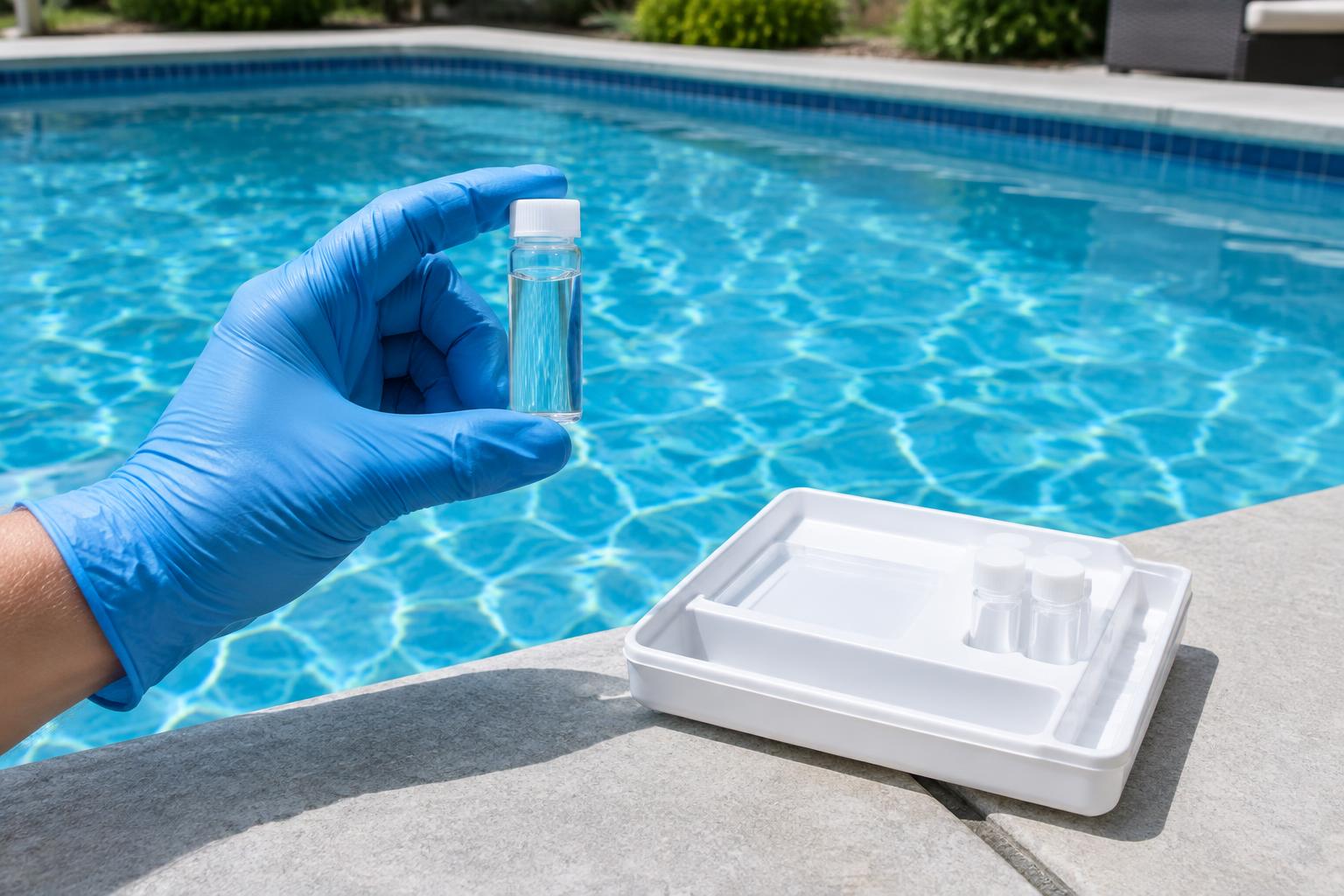
To raise alkalinity in a pool, typically add a sodium bicarbonate alkalinity increaser after testing the water and confirming your pool volume. About 1.4 pounds of sodium bicarbonate per 10,000 US gallons may raise total alkalinity by 10 parts per million (ppm). Follow the product label, add in stages, circulate, and retest before adding more.
What does pool alkalinity do?
Total alkalinity, often shortened to TA, measures water’s ability to resist changes in pH. Think of it as a buffer: when alkalinity is too low, relatively small chemical additions may cause larger pH swings.
Alkalinity and pH are related, but they are not interchangeable. pH describes how acidic or basic the water is right now; alkalinity describes its buffering capacity. You can have low alkalinity with normal—or even high—pH.
Low alkalinity may contribute to unstable water balance. If pH also drops, water may become more corrosive to equipment and certain surfaces. However, irritation, stains, or cloudy water cannot confirm low alkalinity by themselves. Testing is essential.
What alkalinity level should you aim for?
A common working range is 80–120 ppm, although the best target depends on your sanitizer, pool surface, equipment, and manufacturer guidance. Some systems call for a different range, so avoid treating 120 ppm as a universal goal.
| Test result or situation | Typical next step |
|---|---|
| TA below the recommended range | Confirm the reading, then calculate a staged bicarbonate dose |
| TA within the recommended range | Usually leave it alone unless system guidance says otherwise |
| TA above the recommended range | Do not add alkalinity increaser; assess pH and overall balance |
| Low TA with high pH | Confirm both results and plan careful, staged adjustments |
| Uncertain or inconsistent results | Repeat testing with fresh reagents or seek an independent test |
For plaster pools, especially, alkalinity is only one part of water balance. Calcium hardness, temperature, pH, and other factors also matter. Cyanuric acid can contribute to measured TA, so advanced balance calculations may use an adjusted alkalinity value.
What should you use to raise alkalinity?
Sodium bicarbonate is typically the first choice
Most pool alkalinity increasers contain sodium bicarbonate, the same compound as plain baking soda. It typically raises alkalinity with a smaller effect on pH than sodium carbonate, though some pH increase may still occur.
A pool-labeled product provides dosing and application instructions. If considering household baking soda, check that it is plain sodium bicarbonate without fragrances or other additives, and follow your pool manufacturer’s guidance.
Baking soda and soda ash are different
Soda ash is sodium carbonate. It raises both pH and alkalinity, with a stronger effect on pH, so it is typically used when increasing pH is the main objective.
Do not substitute products scoop-for-scoop. Check the active ingredient rather than relying on packaging terms such as “balance” or “pH booster.” Baking powder is not a substitute for baking soda.
How to raise alkalinity in a pool: step by step
-
Test alkalinity and pH together. Use a reliable drop-test kit or fresh test strips, following the testing instructions closely. Also check sanitizer levels. If the alkalinity reading seems unusual, repeat it before dosing.
-
Confirm your pool’s water volume. Use the builder’s records or a volume calculation based on the pool’s dimensions and average depth. Dose for the actual water volume, not just the pool’s advertised capacity. Volume errors can turn a reasonable calculation into an overdose.
-
Choose a suitable target. Start with your equipment and chemical manufacturer’s recommendations. If your range is 80–120 ppm and the reading is 60 ppm, an initial target of 80 ppm may be more sensible than immediately aiming for the upper limit.
-
Calculate the approximate dose. Use the product label first. For sodium bicarbonate, the estimate below provides a useful cross-check, but product composition and actual pool volume may affect the result.
-
Add a partial dose as directed. Consider starting with roughly half to three-quarters of the calculated amount unless the label specifies otherwise. With circulation running, apply the product where and how the label directs. Do not pour it into a skimmer unless expressly instructed. Predissolve only if directed, adding chemical to water—not water to chemical.
-
Allow mixing time, then retest. Keep the pump operating for the label’s specified period. Mixing time varies with pool size and circulation; avoid judging the result from a sample taken immediately beside the addition point. Retest both TA and pH before calculating any remaining dose.
-
Check overall balance before swimming. Confirm that pH and sanitizer are within the recommended ranges and that any label waiting period has passed. Clear-looking water alone does not establish that a pool is ready for swimmers.
How much baking soda does a pool need?
For an approximate starting calculation using sodium bicarbonate:
Pounds needed ≈ (pool gallons ÷ 10,000) × (desired TA increase ÷ 10) × 1.4
These estimates use US gallons and pounds by weight, not cups or fluid ounces.
| Pool volume | Approximate amount for a 10 ppm increase |
|---|---|
| 5,000 gallons | 0.7 lb |
| 10,000 gallons | 1.4 lb |
| 15,000 gallons | 2.1 lb |
| 20,000 gallons | 2.8 lb |
Example: A 15,000-gallon pool tests at 60 ppm, and the chosen initial target is 80 ppm. The desired increase is 20 ppm:
1.5 × 2 × 1.4 = approximately 4.2 pounds.
That is an estimated total correction, not necessarily a single application. Follow the label’s dose limits, add in stages, and let the next test guide further additions.
If you want help organizing your readings, PoolPilot AI can assess submitted test results and suggest next steps. Include your pool volume, product details, and recent chemical additions for useful context. Analyze my pool — free.
Common mistakes and safety precautions
Chasing pH and alkalinity simultaneously. Rapidly alternating acid and alkalinity increaser may create a frustrating correction cycle. Acid lowers alkalinity as well as pH. Make measured adjustments, allow mixing, and retest between treatments. If pH is already high while TA is low, consider professional guidance before making a large addition.
Adding chemicals without checking recent treatments. Recent acid dosing, heavy rain, dilution, or refill water may explain a lower reading. Repeated drops deserve investigation rather than repeated blind dosing.
Assuming more buffering is always better. Excess alkalinity may make pH management harder and, with other imbalances, contribute to scaling or cloudiness.
Ignoring handling instructions. Follow product labels and wear the specified protective equipment. Never mix chemicals together, including in a bucket, scoop, or feeder. Store products securely and separately as directed, and keep swimmers away during treatment. Consult a pool professional for serious corrosion, recurring unexplained imbalance, suspected equipment damage, or uncertain chemical interactions.
FAQ
Can I use regular baking soda to raise pool alkalinity?
Plain sodium bicarbonate may be suitable, provided it contains no additives and your pool guidance permits it. A pool-labeled alkalinity increaser offers clearer application instructions. Calculate by weight and verify the result with testing rather than repeatedly adding household-sized boxes.
How long does it take for alkalinity increaser to work?
The product needs to dissolve and circulate throughout the pool. Follow its specified circulation and retesting interval; there is no single reliable waiting time for every pool. Poor circulation or a large addition may require more time before a sample represents the whole pool.
Will raising alkalinity also raise pH?
Sodium bicarbonate may raise pH somewhat, particularly when starting pH is low. Its effect is typically smaller than soda ash’s effect. Test both values after treatment. If alkalinity is already suitable and only pH is low, adding more bicarbonate may not be the right solution.
Can a photo tell me whether alkalinity is low?
No. A photo cannot measure dissolved alkalinity or establish chemical safety. PoolPilot AI accepts pool photos or test readings for AI-powered assessments, but alkalinity advice needs actual measurements. It offers three free assessments per month with no credit card required. Analyze my pool — free.